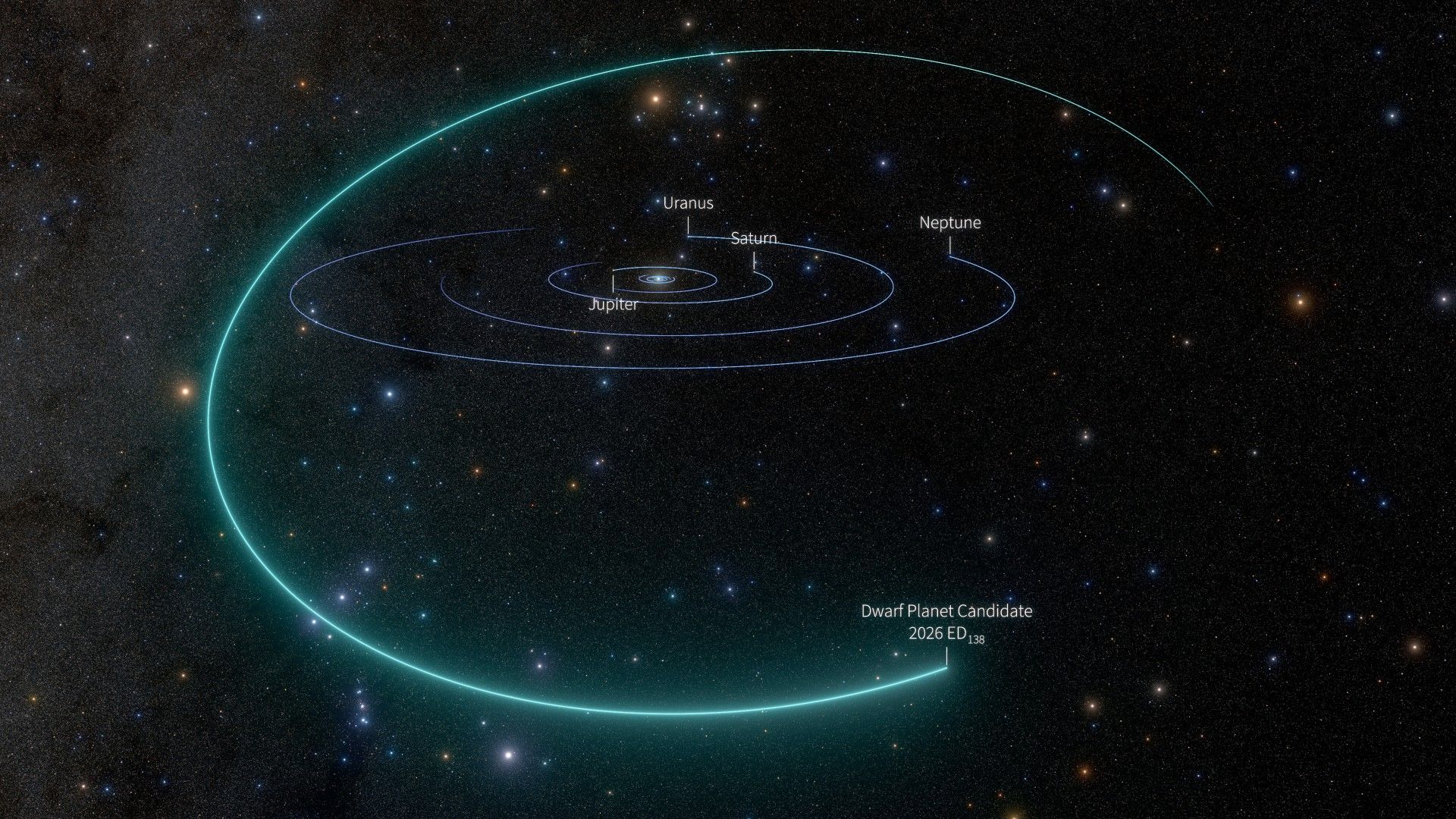
Astronomers have identified a large icy body in the distant reaches of the solar system, and it may qualify as a dwarf planet. The object, designated 2026 ED138, was found in data from the Vera C. Rubin Observatory in Chile, according to Space. Its discovery was announced on Tuesday, Oct. 27.
Matthew Holman, a researcher at the Center for Astrophysics | Harvard & Smithsonian, made the find on Oct. 13. He was running archived Rubin observations through a search program he built with his CfA colleague Kevin Napier when the object appeared in the results.
Space reports that 2026 ED138 is probably between 600 and 1,500 kilometers (373 to 972 miles) across. At that size, its own gravity could plausibly have pulled it into a round shape — the trait that separates dwarf planets from ordinary asteroids.
Why it matters
Only five dwarf planets have been confirmed so far: Pluto, Ceres, Eris, Haumea and Makemake. If 2026 ED138 is added to that list, it would be a rare addition to a very small group of known worlds, as Scientific American and the National Science Foundation have also noted in coverage of the find.
Holman told reporters he was caught off guard by the result. He said his first reaction was excited disbelief, and that because objects of this kind are so uncommon, he began checking right away whether he or the software had made a mistake. Those checks included a careful sweep of the Rubin archive, which confirmed the object was real.
A bright speck in a crowded catalog
The object stood out because it appeared relatively bright despite its great distance from the sun, which suggests it is larger than a typical trans-Neptunian object, Space reports.
Holman and Mario Jurić, Rubin's Solar System Lead Scientist at the University of Washington, established that the observatory recorded 2026 ED138 thirty times across 20 nights between March 4 and July 11 of this year. Older records show the Dark Energy Camera on the Víctor M. Blanco 4-meter Telescope at Cerro Tololo Inter-American Observatory in Chile also captured it, with those observations reaching back to 2016.
The combined data indicate the object's orbit is inclined about 25 degrees to the plane of the solar system. Scientists believe a past gravitational encounter with Neptune likely pushed it into that tilted path. It currently sits roughly 46 astronomical units from the sun — one AU being the Earth-sun distance of about 93 million miles (150 million kilometers) — placing it beyond Pluto's average distance of about 40 AU.
The Rubin Observatory, perched on the 8,799-foot (2,682-meter) Cerro Pachón in northern Chile, has a 28-foot (8.4-meter) primary mirror. It saw first light in April 2025 and began its decade-long Legacy Survey of Space and Time in June. The survey uses a 3.2-gigapixel camera, the largest ever built for astronomy, to image the entire southern sky every few days. Rubin has already logged more than 11,000 new asteroids, and the project is expected to produce a detailed inventory of the solar system while also probing dark matter and dark energy.
One question remains open: whether 2026 ED138 is truly a dwarf planet. That depends on a precise measurement of its size, which will require infrared observations of the kind NASA's James Webb Space Telescope is designed to make. Holman said that if the object is confirmed, it would join a very small family of worlds, and that Rubin's repeated sweeps of the southern sky over the next decade should bring any similar bodies hiding in previously overlooked regions within reach.